By Luis Fernando Rueda Vivas
Director of Organizational Communication, UNAB. Journalist with a Master’s Degree in Digital Communication and a Specialization in Electronic Journalism.
Through a strategic partnership with FOSCAL Clinic, UNAB is strengthening medical training and driving scientific research to enhance stroke care nationwide.
According to the World Health Organization (WHO), a stroke is a medical emergency that occurs when blood flow to the brain is interrupted, either by a blockage caused by a blood clot (ischemic stroke) or by the rupture of a blood vessel resulting in bleeding in the brain (hemorrhagic stroke). In either case, every minute counts — from the onset of symptoms such as sudden vision loss, balance issues, weakness in the arms, facial paralysis, and/or difficulty speaking — until the patient arrives at a medical facility.
That decision about where to seek care can be critical to both treatment and recovery. Amid panic and distress, people often go to the nearest emergency room, which does not always guarantee access to the specialized care required. “It is important to know in every city where the Stroke Center of Excellence is located. When a family member suddenly becomes paralyzed, relatives often take them to the closest hospital, where there may be limited treatment options available,” explains interventional radiologist Daniel Eduardo Mantilla García, coordinator of the specialty program offered jointly by UNAB and FOSCAL Clinic. The program is designed to train neuro-radiologists in Colombia because there are currently fewer than 100 specialists in this field.
To date, ten hospitals in Colombia have earned certification as Stroke Centers of Excellence from the World Stroke Organization (WSO) after meeting rigorous standards that are regularly evaluated and are closely linked to patient outcomes. “We must maintain strict control over treatment times. The WSO reviews our performance indicators every quarter to ensure compliance with established standards, and every two years it conducts on-site visits to validate those processes. FOSCAL has held this certification for the past four years,” Mantilla adds.
Although this network is still developing, the Advanced Medical-Surgical Specialization Program in Interventional Radiology aims to ensure that every major city has at least one center staffed by three highly trained specialists in neurovascular diseases, including conditions such as cerebral aneurysms.
New Scientific Evidence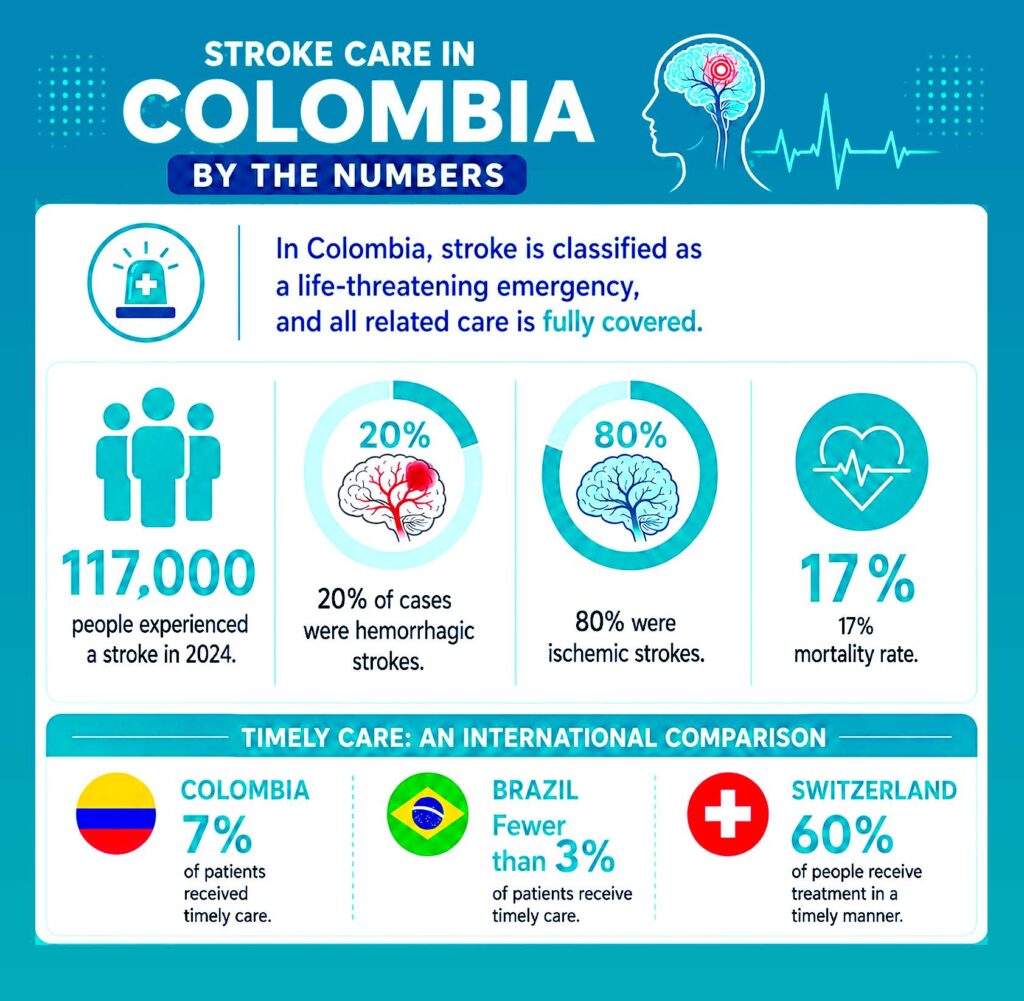
The development of specialized centers for the treatment of aneurysms in Latin America remains fragmented. Mantilla notes that the region tends to rely on evidence from Europe and the United States, while local clinical research is limited.
This led the physician from Santander to raise concerns in academic discussions with colleagues about the need to generate new knowledge, prompting him to supervise the international doctoral thesis Treatment-related complications of intracranial aneurysms smaller than 5 mm: A multicenter analysis of 1,519 cases in Latin America, a retrospective observational study conducted between 2017 and 2023 across eight hospitals. It is the first analysis of its kind in the region and has the potential to inform clinical practice across the continent.
The study, led by Dr. Alejandra Jaume of the Neurology Department at Maciel Hospital and the Vascular Interventional Center at Clínica Americana in Montevideo, Uruguay, confirmed that endovascular treatment is less likely to result in complications causing permanent neurological disability than surgical treatment. The rate was 6 cases per 100 patients with endovascular treatment, compared with 11 per 100 patients undergoing surgery.
There are risks both during surgery and throughout the recovery period. The greatest risks are concentrated in the first 48 hours following the procedure, although additional complications may arise during the following month, depending on the type of treatment. “Typically, after endovascular surgery, the patient spends 24 hours in the Intensive Care Unit for postoperative monitoring. They then spend another 24 hours in a general hospital ward, where they should remain active, walk, and resume their daily activities. Three days after the procedure, patients who undergo endovascular surgery are discharged home and can return to their normal lives,” explains the specialist.
Aneurysms smaller than 5 mm carry a lower risk of rupture. However, clinical practice has shown that 30% of people who arrive at an emergency department with a hemorrhage had an aneurysm of this size. “This subgroup of patients is particularly interesting to study because the risks of treatment and follow-up must be compared in order to determine, first, which patients are at risk of a small aneurysm rupturing, and second, whether preventive surgery can be performed safely and effectively. The risks of treatment should never exceed those associated with the natural progression of the disease,” Mantilla adds.
Another important finding from the research relates to the training of specialists and the need to ensure adequate clinical experience. The study demonstrated that surgeons who perform more than ten endovascular procedures for cerebral aneurysms per year experience fewer treatment complications, reinforcing the need to concentrate specialized expertise and strengthen medical training across the region.
Universidad Autónoma de Bucaramanga – UNAB | Sujeta a inspección y vigilancia por parte del Ministerio de Educación Nacional | Resolución 3284 (21 diciembre de 1956), Ministerio de Justicia | Resolución 012987 del 31 de julio de 2023, mediante la cual otorga la renovación de la Acreditación Institucional de Alta Calidad a la Universidad Autónoma de Bucaramanga, con domicilio en la ciudad de Bucaramanga, por 6 años. | Avenida 42 No. 48 – 11, Bucaramanga – Colombia. | PBX (57) (7) 643 6111/643 6261 | Centro de contacto: 018000 931170| Correo institucional: contactenos@unab.edu.co | Notificaciones judiciales: juridica@unab.edu.co | Aviso de Privacidad | © Todos los derechos reservados

 By Franz Dieter Hensel Riveros
 Por Erika Alcira González Pinto