By Xiomara Karina Montañez Monsalve
Editor. Social Communicator and Journalist, with a Master’s Degree in Political Science and a Specialization in Education for New Technologies.
Santander has a steady stream of literary production, but historically it has been overshadowed by other commercial hubs such as Bogotá and Medellín. Today, the region is transforming the individual efforts of authors and independent publishers into a more collaborative ecosystem capable of meeting commercial and positioning challenges.
The publishing ecosystem in Bucaramanga is undergoing a transition toward greater professionalization and stronger collaboration among writers, independent publishers, reading promoters, and UNAB University through Ulibro and the Libros Nuestros project. According to Camila Botero Santos, director of UNAB Cultural, Libros Nuestros was created to move beyond isolated initiatives and establish a shared strategy for strengthening the city’s publishing sector.
«We realized that, largely thanks to the grants and incentives awarded in recent years—which have also encouraged book publishing—independent publishers have become stronger, helping the sector move beyond its longstanding fragmentation,» says Botero Santos.
The initiative is already yielding results. The Ulibro website now features a directory of 12 independent publishers in Bucaramanga and, with support from the Virtual Literature program, seeks to strengthen their work. In addition, a comprehensive assessment of the sector is underway and will be published at the end of 2026. The study aims to identify authors, editors, illustrators, distributors, and other stakeholders, better understand how they operate, and strengthen regional collaboration.
From a «One-Man Band» to a Publishing Value Chain
One of the sector’s realities is that, in most cases, authors handle every stage of the publishing process themselves. Through Libros Nuestros, they are encouraged to adopt more professional publishing practices by incorporating services such as copyediting, editorial review, graphic design, and other quality-control processes.
The project team argues that part of every publishing budget should be allocated to hiring professional editors, designers, proofreaders, and other specialists, thereby strengthening both production capacity and distribution.
«Public funding has always been limited, and much of the cultural and publishing sector has depended almost entirely on those resources. Santander needs more sustainable management models, and that requires recognizing the sector itself and building trust among its stakeholders. Grants are only one source of funding—we must identify new funding opportunities,» says Botero Santos.
Commercial Barriers
Limited commercial partnerships are another major challenge. This year, during the Feria del Libro (Bucaramanga Book Fair), roundtable discussions will bring together schools, employee compensation funds, and businesses to showcase publications produced in the region and encourage institutional purchases.
Administrative barriers must also be addressed. Many publications still lack an International Standard Book Number (ISBN), issued by the Colombian Book Chamber, which is essential for registering a publication and accessing the legal benefits available to publishers.
According to the director of UNAB Cultural, the region already produces technically outstanding books capable of competing nationally, particularly in poetry, illustrated books, and children’s and young adult literature. However, these publications are not reaching educational institutions—the very audience they are intended to serve.
«At the end of 2025, we organized a meeting with schools and invited principals and librarians. We brought around 15 books for them to review, and they were genuinely impressed by the quality. They had no idea these titles were produced in Santander. While it’s unfortunate that these authors remain largely unknown locally, it was also revealing to discover that many publishers simply don’t have the production capacity to meet schools’ demand,» Botero adds.
Institutional Support
For Isaías Romero, a writer, columnist from Cúcuta, and member of the project, institutional support—from municipal governments, the departmental government, and the private sector—remains limited. Although financial support is available for authors, publishers receive no such support.
Camila Botero explains that a draft Municipal Cultural Promotion Agreement is being developed for the metropolitan municipalities of Bucaramanga, Floridablanca, Girón, and Piedecuesta. The proposal, scheduled to be presented to the municipal councils during the second half of the year, seeks to establish a long-term public cultural promotion program.
Among its objectives are ensuring that support for reading and writing does not depend on the priorities of a particular administration, institutionalizing public grant programs with transparent selection criteria, and adopting a metropolitan approach that removes geographic barriers for authors.
«Financial awards are often exclusionary. For example, grants offered by Bucaramanga frequently exclude authors who live in neighboring municipalities such as Floridablanca or Girón. Funding is awarded, but not through open public calls—in some cases, it is granted solely through administrative resolutions. I believe the real problem is the lack of political will to ensure continuity in public cultural programs and to appoint qualified professionals to the positions that require them,» concludes Botero Santos.
Books Must Circulate
According to Isaías Romero, a reading promoter in the Santander region, the initial findings of the sector assessment identified nearly 150 reading promoters in Bucaramanga. In 2025, the two Santander departments collectively published an average of one book per week—a remarkable figure for a region with relatively few public libraries and limited public funding.
Self-publishing remains the dominant model. While it gives authors greater creative independence, it often comes at the expense of professional quality standards.
«The author receives a grant and decides not to hire an illustrator or a copyeditor, even though those professionals are available. They prefer to save money so they can get the book published,» Romero explains.
The assessment also identified publishing houses created through collaborations among authors with shared interests who publish under a common imprint. Grants often require books to be published, yet there are no resources available to establish publishing companies.
Meanwhile, universities and schools are interested in purchasing books by regional authors but frequently discover that many titles lack an ISBN or that publishers cannot issue invoices.
«The reality is that limited book circulation affects the entire publishing ecosystem,» Romero concludes.
Weaving the Region’s Book Network
Why do many local authors struggle to recognize that they are not the only key players in producing and publishing a book?
For author and illustrator Carlos Díaz Consuegra, the answer lies in perception. He explains that authors often believe their creative work is “everything,” without recognizing that publishing is a collaborative effort involving many professionals working together.
He argues that a book “shouldn’t be viewed simply as something you produce to recover printing costs or to see how successful it becomes.” A high-quality publication can reach international bookstores, institutional catalogs, and readers around the world.
For that reason, strengthening the publishing value chain requires addressing the tensions that exist between creative work and commercial development in Santander.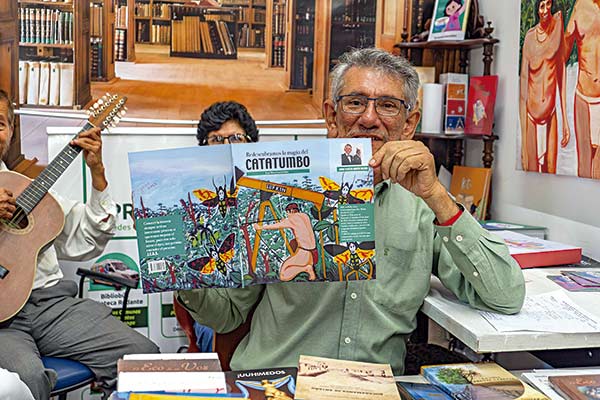
“Our goal with Libros Nuestros is to better understand the scope of the publishing sector and stop treating books as though they exist outside the economy or have no role in a country’s development simply because they aren’t seen as products for everyone,” says Díaz Consuegra.
He also believes stronger campaigns are needed to promote reading and demonstrate the value of books in everyday life, since there is no government support for this. “If there were genuine incentives to encourage reading, people would realize that books are useful, enjoyable, and powerful spaces for conversation,” he says.
Finally, he encourages local creators to replace competition with collaboration. “When I attend international book fairs, I take projects by other local illustrators with me. If they sell a book, our entire creative community becomes stronger—and that’s what really matters. If Bucaramanga’s publishing scene becomes recognized, we all gain visibility.”
 By Franz Dieter Hensel Riveros
 Por Erika Alcira González Pinto