
By Andrés Felipe Acosta Rodríguez
Journalist and specialist in Digital Communication and Interactive Media, with experience in content writing for digital environments.
Specialists from UNAB and the University of Pamplona are leading a project to replicate the natural function of human limbs. So far, the technology has been successfully validated through mixed reality simulations, where it has already had a profound emotional impact on patients with limb differences.
The project is titled Design, Construction, and Adaptation of Smart Prosthetics with Sensitive Artificial Skin for the Upper Limb (Wrist-Hand) and Lower Limb (Ankle-Foot) for a Girl with Congenital Malformations from the City of Cúcuta, Norte de Santander.
“When the young girl used the simulation and was able to see and move her limbs, she experienced a strong emotional reaction. Within minutes, she began to cry because she felt she could actually have those limbs. This shows that we are not only developing technology, but also creating real opportunities to transform lives,” the team of specialists explained.
The project is led by Antonio Faustino Muñoz Moner (UNAB) and Aldo Pardo García (University of Pamplona), who have spent years researching system simulation through autonomous technologies. In this project, that expertise has been applied to the biomedical field, with the goal of designing an artificial limb that not only restores movement but also incorporates sensory and adaptive capabilities.
“Traditional prosthetic technologies often produce movements that lack the natural motion and coordination of a healthy limb. As a result, users walk with an uneven gait and are never able to achieve truly natural movement. In many cases, these prototypes fulfill a basic function but remain biomechanically inefficient. Our approach begins by recognizing those limitations and proposing something different: not simply restoring movement, but replicating the behavior of a healthy limb,” explained Muñoz Moner.
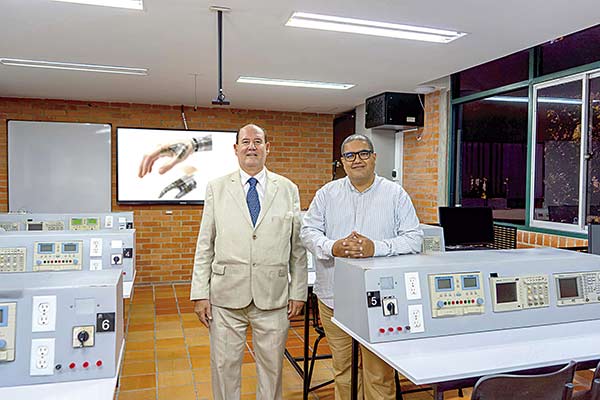
The UNAB researcher also explained that artificial cloning involves designing intelligent micro- and nanoelectromechanical systems capable of autonomous learning to replicate the behavior of healthy limbs using fuzzy clustering techniques.
The project is currently in an intermediate stage of development. Researchers have already created virtual prototypes of the wrist-hand and ankle-foot prostheses and carried out simulation tests using the patient’s actual body measurements. This methodology prioritizes digital validation before physical manufacturing, allowing the design to be refined and potential improvements to be identified before production.
“Modern design methodologies begin with a virtual prototype. We have successfully simulated the prostheses and validated that they function as intended before moving on to physical construction. This enables us to optimize the design and reduce uncertainty in the later stages of development,” Professor Muñoz said.
A Sensitive Element
One of the project’s most innovative features is its artificial skin, which is capable of sensing environmental stimuli. Made from nanomaterials, it incorporates sensors that detect variables such as temperature, humidity, and touch, adding an entirely new dimension to the prosthesis’s functionality.
“The artificial skin incorporates mechanisms that detect environmental stimuli much like human skin does. Developed at the nanoscale, these materials possess self-assembling, self-replicating, and self-coupling properties that traditional materials do not have, allowing them to adapt to the biological system,” explains the UNAB Mechatronics Engineering professor.
Unlike other developments that require complex surgical procedures to integrate with the body, this approach is non-invasive. The self-assembling properties of the nanomaterials would allow the device to attach directly to the skin without surgery, representing a significant advantage in terms of accessibility, safety, and ease of implementation for patients.
The movement system relies on electromyographic signals and machine-learning algorithms to replicate the behavior of a human limb. As a result, the prosthesis functions not simply as a mechanical device, but as an adaptive system capable of responding to both the user’s needs and changing environmental conditions.
Professor Muñoz added that “the information captured by the artificial skin is not used to generate movement, but rather to protect the artificial limb by detecting hot surfaces, obstacles, and environmental conditions. This is achieved through learning systems that process biological signals using intelligent algorithms.”
The conceptual foundation of this development is artificial cloning, a methodology that combines genetic algorithms, fuzzy logic, and neural networks to reproduce the behavior of real systems. This approach has previously been applied in industrial settings, where it has demonstrated its ability to reproduce sensors and devices with high accuracy at a lower cost.
 By Franz Dieter Hensel Riveros
 Por Erika Alcira González Pinto