By Andrés Felipe Acosta Rodríguez
Journalist and specialist in Digital Communication and Interactive Media, with experience in content writing for digital environments.
A classic ophthalmic instrument has been transformed through digital technology to improve clinical accuracy, reduce subjectivity in measurements, and support surgical decision-making where every tenth of a millimeter is critical.
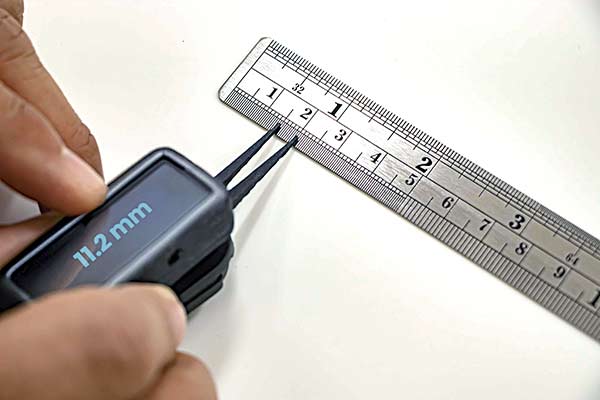
In procedures where even the slightest variation can directly affect a patient’s vision, this level of subjectivity can become a significant challenge. The need for greater precision led to a key question: Is it possible to preserve the functionality of the Castroviejo caliper while incorporating technology that enables objective, reproducible, and more precise measurements?
The answer took shape in the digital Castroviejo caliper, a device that preserves the operating principle of the original instrument while integrating electronic components capable of converting physical movement into a real-time digital reading accurate to tenths of a millimeter.
“The classic Castroviejo caliper has markings every millimeter, but no subdivisions. So, when the measurement falls between 10 and 11 millimeters, the surgeon must estimate whether it is 10.3, 10.5, or 10.8. It works, but it depends heavily on the observer’s eye. We felt it was time to develop something more precise—something that didn’t rely on that subjectivity,” said ophthalmologist Alejandro Tello Hernández, Ph.D. in Vision Sciences and professor at UNAB University.
That clinical need became the starting point for an interdisciplinary co-creation process in which medicine and biomedical engineering came together to transform a clinical challenge into a viable technological solution.
Biomedical Engineering Applied to Ophthalmology
The challenge was not simply to digitize a measurement, but to do so without altering the instrument’s ergonomics, ease of use, or suitability for the clinical environment. Added to this was another essential requirement: the device had to be sterilizable and compatible with surgical protocols.
Researchers in UNAB’s Biomedical Engineering program designed a compact system that integrates an encoder sensor capable of recording the caliper’s movement, a microprocessor that interprets the signal, and a digital display where the measurement can be viewed instantly and clearly.
“We took the clinical idea and turned it into a functional prototype. The biggest challenge was fitting the electronic components into a very small space while ensuring the device could be sterilized. We created a system that digitizes the measurement, delivers reproducible results, and complies with the protocols required for the clinical setting,” explained Lusvin Javier Amado Forero, professor in the Biomedical Engineering program.
The result is a device that can function as a standalone instrument or be adapted to existing traditional calipers, expanding its potential applications without requiring a radical change in medical practice.
The value of the digital Castroviejo caliper becomes especially clear in procedures where extreme precision is required, such as selecting phakic intraocular lenses for young patients with high myopia. In these cases, accurately measuring the corneal diameter is essential for determining the correct lens size, and even small differences can affect the final visual outcome.
“When calculating the size of these lenses, the accuracy of the corneal diameter is critical. A difference of a few tenths of a millimeter can influence the final outcome. Having an objective, digital measurement helps ensure safer and more consistent clinical decision-making,” noted Tello Hernández.
To date, the digital Castroviejo caliper has been evaluated only in preclinical testing using inert materials and artificial eyes. It has not yet been tested in patients, as this stage requires approval from ethics committees and regulatory authorities such as Invima (Colombia’s National Food and Drug Surveillance Institute). This is a standard step in the development of medical devices and is essential to ensure the technology is both safe and clinically effective.
“Every medical device must undergo a rigorous development process. This is a very important first step because it demonstrates that the concept works, that it is viable, and that it has genuine potential for clinical application,” said the ophthalmologist.
This work is part of an academic and scientific partnership between UNAB University and the Santander Ophthalmological Foundation (FOSCAL). The patent for the Digital Castroviejo Caliper for Measuring Corneal Diameter was granted to the University by Colombia’s Superintendency of Industry and Commerce through Resolution No. 9767, with patent protection in force until 2042.
 By Franz Dieter Hensel Riveros
 Por Erika Alcira González Pinto