By Carolina Toscano Vargas
Head of Content, Journalist, Human Resources Management Specialist, Certified Spanish as a Foreign Language (ELE) Teacher.
José Luis Garcés Bautista has developed a validation model for Born Global startups. His tool assesses the innovation and international capabilities needed to export successfully from day one.
In Latin America’s traditional business ecosystem, internationalization has historically been viewed as a gradual process. The conventional model suggests that a company must first establish itself in its domestic market and, after years of growth, venture abroad. However, doctoral research conducted by financial engineer José Luis Garcés in Santander, Colombia, points to a different model: Born Global companies. These organizations do not view international markets as a distant goal but as their starting point.
Based on research published in the Scopus scientific database, Garcés not only analyzes this phenomenon in the region but also provides a practical tool for entrepreneurs to assess their export potential from day one. Unlike companies that internationalize their operations in stages, a “Born Global” company is founded with the intent to export.
According to Garcés, who is also a professor, these firms emerge in response to an unmet need in international markets that conventional companies are not addressing. In his research, Garcés shows how these firms identify an opportunity in a foreign market and design their products, warranties, and technical specifications to respond exclusively to that demand.
These organizations share several defining characteristics, such as innovation (the product must have a high component of added value, design, or technology); a global mindset (founders and managers develop their production processes according to international standards); and they are most commonly found in software and technology, advanced manufacturing, and service industries.
One example cited by the researcher is a company from Santander, located between Oiba and Barbosa, which—without realizing it—was operating as a Born Global company by exporting coffee cubes. Although coffee is an agricultural product, its innovative format enabled the company to reach international customers directly through digital platforms.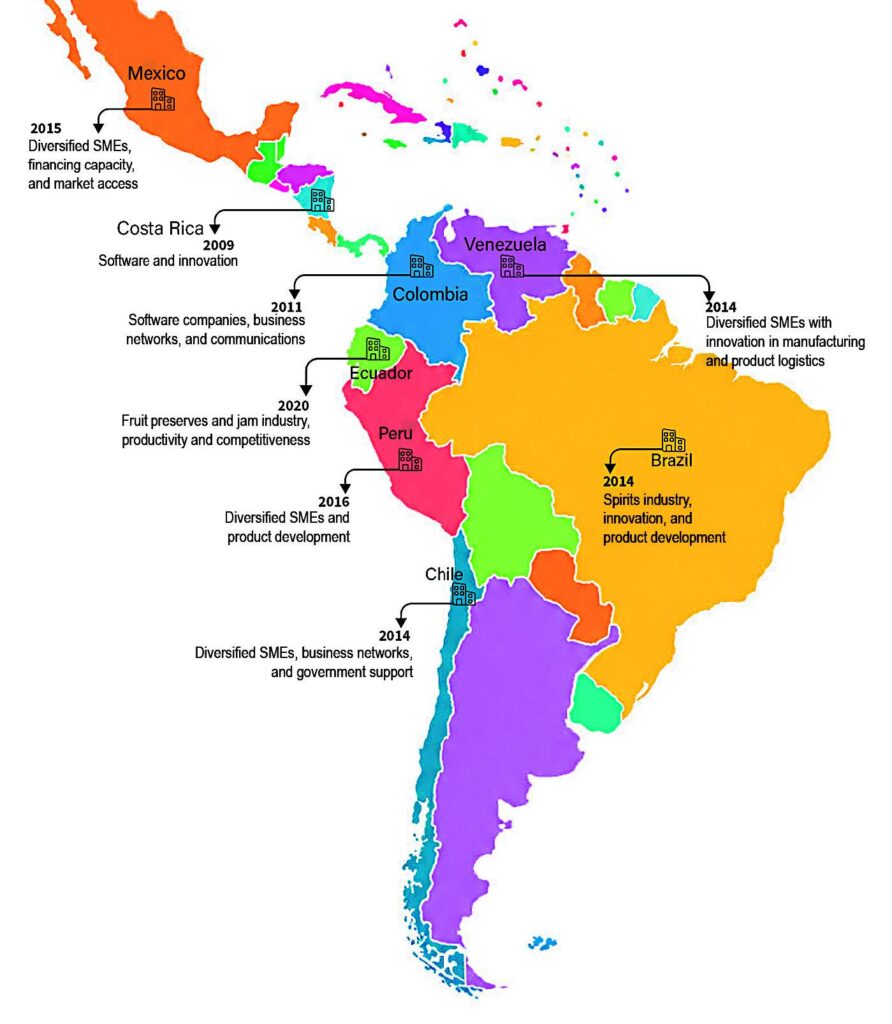
A Validation Model and Strategic Roadmap
At the heart of Garcés Bautista’s research is a structured self-assessment model. Validated by experts from the oil and gas industry, academia, and chambers of commerce, the model is divided into three key phases.
The first focuses on identifying global opportunities, requiring innovators to evaluate their «global mindset.» The model asks whether they truly understand the culture, economy, and political context of their target market. «If I’ve never exported, traveled abroad, or become familiar with international negotiation processes, the model will raise a red flag,» explains the professor.
The second phase—development and strategy—assesses a company’s ability to build strategic partnerships, since a Born Global company cannot operate in isolation. It requires a strong support network that includes global marketing, communications, and, above all, skilled professionals capable of strengthening every level of the organization.
The final phase focuses on risk assessment and management. Given the uncertainty of international markets, the model emphasizes continuous evaluation of strategic effectiveness and careful management of macroeconomic and cultural risks.
Challenges in Latin America
The research provides an overview of how this phenomenon has developed across Latin America, highlighting cases such as Medellín, where in 2011 a software company adapted its operations to the business hours of Japan and China. In Ecuador, the pandemic boosted exports of processed products such as jams, while Brazil has found success with cachaça, and Chile with specialized software for small and medium-sized enterprises (SMEs).
Despite these examples, experts such as José Luis Garcés say that in Santander and much of Latin America, economic opportunities are being missed due to a fear of the unknown, a lack of documentation of innovations, and a tendency to prioritize the local market—which ultimately dilutes the innovative nature of their products.
A Call for Collective Action
The contribution by Garcés Bautista of the School of Economics and Business goes beyond academic theory; it offers a practical roadmap with strong potential for real-world application. He also proposes a coordinated partnership among three key actors: academia, providing validation tools; government institutions—including ProColombia and the chambers of commerce—facilitating financing and market access; and the private sector, willing to assume the risks of international expansion.
The message is clear: entrepreneurs do not need to wait until they have large-scale infrastructure to think globally. If a product offers genuine innovation and its founder develops an international business mindset, borders become merely geographical references rather than commercial barriers. Garcés’s model is ready to serve as a catalyst for transforming local ideas into successful global businesses.
 By Franz Dieter Hensel Riveros
 Por Erika Alcira González Pinto