By Nicolás Jiménez Blanco
Former writer at Vanguardia with experience in social media. Currently a Social Communications professional at Universidad Autónoma de Bucaramanga.
From academia to the operating room, these projects—two medical devices and two digital platforms—aim to strengthen patient safety and modernize hospital services through a joint effort with FOSCAL Clinic in Bucaramanga.
Healthcare excellence is often associated with technological hubs such as Taipei, Taiwan, ranked by the Numbeo database as the city with the world’s best healthcare system. Yet Bucaramanga is emerging as a local innovation ecosystem with global impact.
This is evident in the strategic alliance between UNAB University, FOSCAL Clinic, and UNAB’s Biomedical Engineering program, which have developed four cutting-edge projects: an identification-enabled umbilical clamp, a dressing for the treatment of second-degree friction burns, and two digital platforms—a smart voice assistant for completing surgical checklists and an emergency app for hospital pre-triage.
All are specifically designed to address critical safety failures and modernize hospital management. While these innovations represent an important academic achievement, they are also a tangible response to the needs of hospitalized patients.
Safety from the First Breath: The Umbilical Clamp
Imagine being handed a baby at the hospital who, years later, turns out not to be your child. This happened, for example, at a hospital in Barranquilla in 2020. Two newborns had been switched at birth in 2016, and the mistake was only discovered four years later. The case highlighted that traditional identification wristbands—which record basic information such as the mother’s name, weight, length, and date and time of birth—while essential, remain vulnerable to human error.
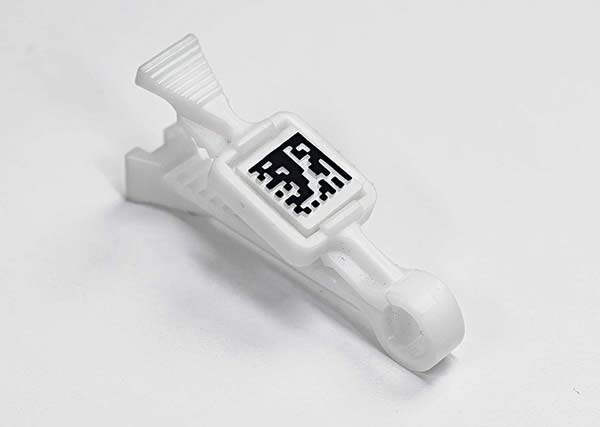
To help prevent this, researchers in UNAB’s Biomedical Engineering program developed an umbilical clamp that not only serves as an identification tool but also seals the umbilical cord stump, helping prevent bleeding and infection while promoting drying and natural detachment.
“We designed the device using biomaterials that are non-toxic to the baby and linked it directly to the mother,” explains professor and researcher Mateo Escobar Jaramillo.
The device was designed using CAD software and manufactured through 3D printing. It incorporates a unique QR code that digitally links the baby to the mother. “There are occasions when the clamp doesn’t stay in place, so we created an integrated system that includes a medical-grade silicone wristband for the baby, another for the mother, and a mobile app containing all their records,” adds Escobar Jaramillo.
Geometry for Healing Complex Wounds
Second-degree burns are difficult to treat. Traditional treatment, often painful and prolonged, can take up to three weeks to heal and requires a dressing that remains securely in place despite movement. Bucaramanga has only two specialized burn units capable of treating these injuries. To help address this challenge, UNAB developed the Auxetic Geometry Dressing for the Epithelialization of Second-Degree Friction Burns, which facilitates the initial treatment of these injuries, even in settings with limited access to burn specialists.
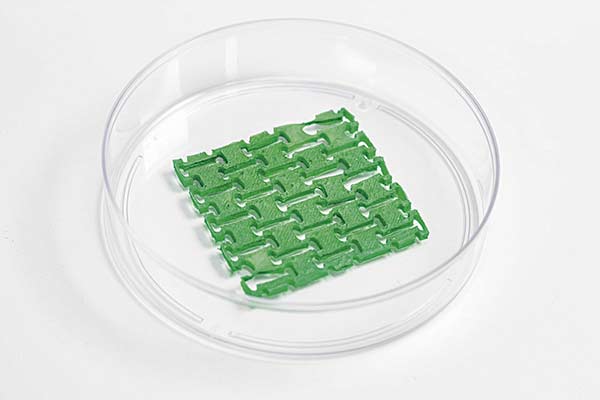
A dressing is a medical device used to cover and protect a wound—similar to an adhesive bandage—while auxetic geometry refers to a specially designed internal structure that expands when stretched and contracts when compressed. This ensures that the wound remains covered even when the patient moves the affected joint.
As Natalia María Escobar Lamus, a ninth-semester Biomedical Engineering student, explains, “We identified a gap in the healing process for these wounds because the affected area was not healing properly. We analyzed different auxetic geometries and evaluated which performed best. We used compounds such as silver sulfadiazine, an antibiotic used to treat wounds, agarose hydrogel, which forms the dressing itself, and added 2.7% Fitostimoline to promote the regeneration of epithelial tissue.”
Artificial Intelligence in the Operating Room
You may have undergone surgery for an appendectomy, cholecystectomy, abdominoplasty, or rhinoplasty. Besides being among the most commonly performed procedures in Colombia, they all have one thing in common: every patient entering the operating room must be manually documented on a surgical safety checklist before, during, and after the procedure.
Yet even in 2026, this documentation process remains a challenge for hospitals. Because it is completed manually, documents can be misplaced and staff may inadvertently omit information, compromising data traceability and patient safety.
To address this problem, researchers developed an intelligent voice assistant that automates completion of surgical safety checklists by using artificial intelligence to recognize both the user’s and the physician’s voices.
“This project is currently at Technology Readiness Level 3 (TRL). That means a functional prototype has been successfully validated in laboratory testing and is now ready for evaluation in real-world settings. The students are the key contributors because they implement the ideas and produce the results,” says UNAB professor Luis Felipe Buitrago Castro.
The system features a modular design consisting of OpenAI’s Whisper speech-recognition system, an automatic correction and document-completion module, an interactive user interface, and a database for organized document storage.
Digital Emergency Care
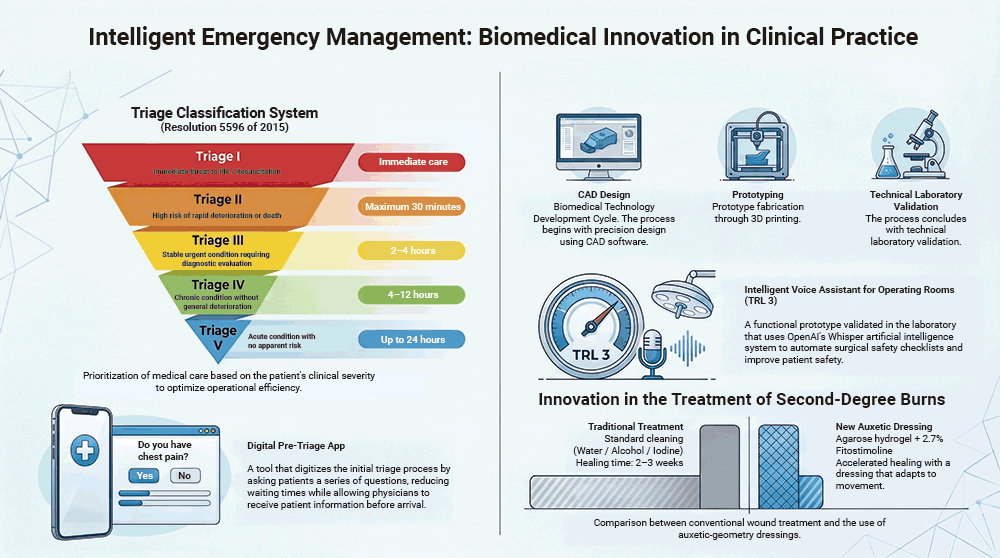
Emergency departments use a patient classification system known as triage. Under Colombia’s Ministry of Health and Social Protection Resolution 5596 of 2015, patients are classified into five levels according to clinical severity rather than order of arrival, using numbered levels and color codes (see inverted pyramid diagram). However, the system faces challenges including overcrowding, long waiting times, and technological limitations that affect both operational efficiency and patient safety.
To address these challenges, UNAB’s Biomedical Engineering program developed the Digital Pre-Triage System for the emergency department at FOSCAL Clinic—an app designed to optimize the initial triage process by digitizing patient classification. “Our application presents patients with a series of questions that guide them through the pre-triage process. The physician on duty receives the patient’s information before they arrive, allowing us to reduce waiting times and prioritize care,” explains Professor Buitrago Castro.
The application was developed using a structured design process based on software requirements engineering and built with web technologies that follow international standards
 By Franz Dieter Hensel Riveros
 Por Erika Alcira González Pinto