By Pastor Virviescas Gómez
Special Correspondent for Open Science at UNAB. Reporter with 40 years of experience and three Simón Bolívar Journalism Awards.
By Xiomara Karina Montañez Monsalve
Editor. Social Communicator and Journalist, with a Master’s Degree in Political Science and a Specialization in Education for New Technologies.
The UNAB Institute of Political Studies (IEP) presented an assessment of the restorative justice project carried out in Santander and Norte de Santander, with the participation of offenders, victims, community leaders, and public institutions. Among its recommendations to the JEP (Special Jurisdiction for Peace), the study highlighted the continuing armed conflict and the challenges of providing reparations to victims in their own territories.
Conducting the research meant leaving the university classrooms behind, spending nights away from their families, pulling on rubber boots, battling mosquitoes, and even being confronted by a guerrilla unit that demanded to know why they had come to such a remote village in Colombia’s Catatumbo region in Norte de Santander.
María Eugenia Bonilla Ovallos, Director of UNAB University’s Institute of Political Studies (IEP), and her colleagues experienced this firsthand while conducting fieldwork for the project Restorative Justice and Territoriality: Recommendations for Strengthening Restorative and Reparative Initiatives in Norte de Santander and Santander. In November 2023, the proposal received a perfect score of 100 points, ranking second among 734 eligible projects and first among the 118 submitted in the Social Sciences category of the Ministry of Science, Technology and Innovation’s (MinCiencias) 937th Call for Fundamental Research.
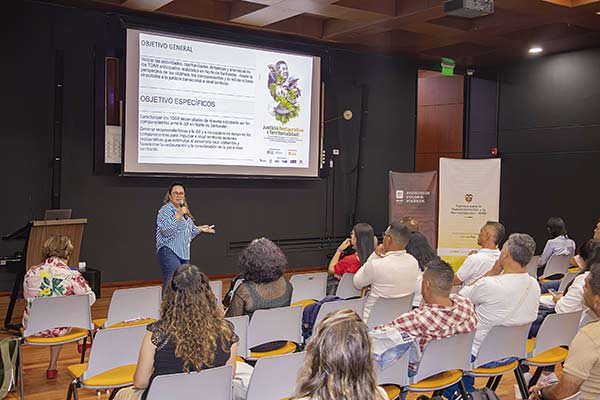
On May 7, the research team presented its findings in the Jesús Alberto Rey Mariño Auditorium at UNAB’s El Jardín Campus. Using a participatory action research methodology, the study involved 128 victims, 48 individuals appearing before the Special Jurisdiction for Peace (JEP), and 30 leaders and representatives of social organizations and public institutions from territories affected by the armed conflict in Santander and Norte de Santander.
The research also examined 218 TOARs (Restorative and Reparative Works, Projects, and Activities)—restorative justice measures carried out under the JEP by former FARC-EP combatants, current and former members of the security forces, other state agents, and civilian third parties who took part in crimes committed during the armed conflict.
According to Bonilla Ovallos, the researchers analyzed more than 45 documents detailing the structure of transitional justice and the regulatory commitments following the signing of the Peace Agreement—the theoretical basis that enabled the conduct of 16 focus groups and 34 in-depth, semi-structured interviews with the aforementioned population. “ In total, nine field visits were made to prioritized municipalities and the Catatumbo subregion, where we were able to directly observe the TOARs and engage in dialogue with stakeholders involved in the process,” explained the director of the IEP UNAB during the presentation of the research findings.
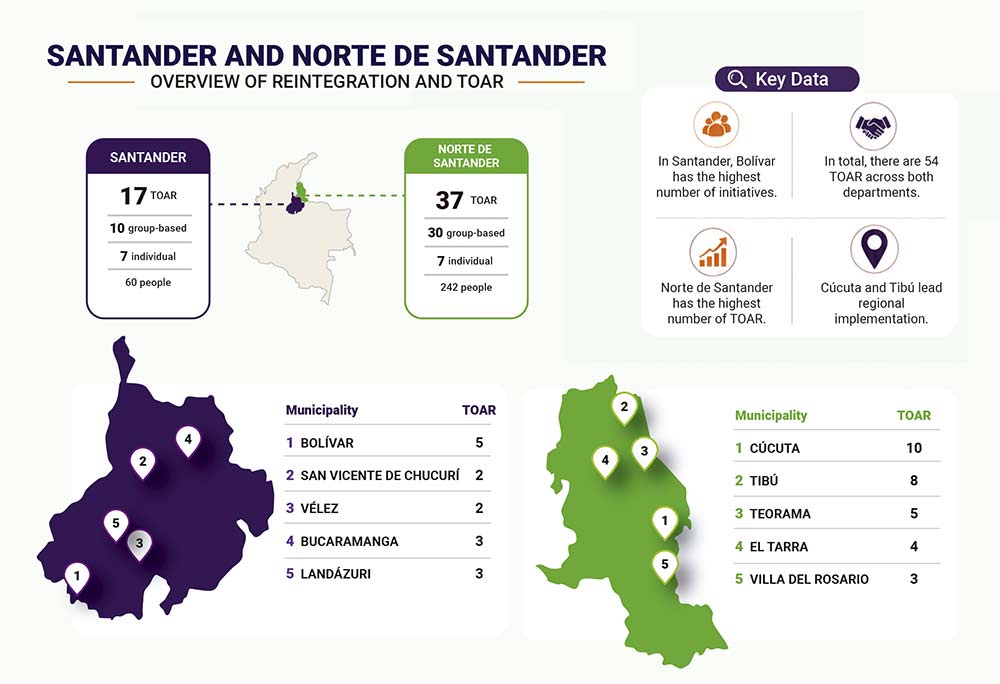
She also highlighted that, in both Santander and Norte de Santander, the TOARs have included initiatives such as symbolic reparations, the preservation of historical memory, and the conservation of rural and urban infrastructure, as well as efforts focused on environmental protection, peace education, the fight against antipersonnel mines, and the search for missing persons (see maps of Santander and Norte de Santander).
The study found that early TOARs—that is, cases in which individuals appearing before the JEP contribute to truth-telling efforts before receiving a sentence—have reached 75% territorial coverage nationwide. Despite this broad reach, the initiatives remain geographically concentrated: 45% are located in just five departments: Norte de Santander (19.6%), Antioquia (11.85%), Putumayo (7.80%), Caquetá (7.51%), and Cesar (7.23%), according to the report The JEP’s 80 Achievements of 2025.
María Eugenia Bonilla points out that Norte de Santander has become the national leader in the implementation of early restorative and reparative actions, with projects carried out in municipalities such as Villa del Rosario, El Tarra, Teorama, Tibú, and Cúcuta—even as the armed conflict continues in the region. In Santander, which ranked seventh nationally in the JEP’s previous TOAR assessment, 6.36% of the actions were concentrated in Vélez, San Vicente de Chucurí, Landázuri, Bucaramanga, and Bolívar (see map of Santander and Norte de Santander).
By 2025, the JEP’s Executive Secretariat had certified 237 of the 355 TOARs submitted nationwide. Spanning 27 departments and 107 municipalities, these initiatives involved 4,158 participants, including Peace Agreement signatories and other individuals appearing before the JEP. Among them were 146 individuals identified as bearing the greatest responsibility for crimes committed during the armed conflict.
Impact of the Results
Aware of the risks involved in their work, but also of the enormous expectations surrounding its results, the research team succeeded in peacefully bringing together, in a single forum at the Alfonso Gómez Gómez Auditorium, former FARC-EP commander Pastor Lisandro Alape Lascarro and retired General Paulino Coronado Gámez, former commander of the National Army’s 30th Brigade. Serving as special witnesses were members of the Catatumbo Women’s Network, who reaffirmed their demands for truth, justice, reparations, and guarantees of non-repetition for the many crimes committed during the armed conflict, including the extrajudicial executions that some, using deliberately misleading language, labeled “false positives.”
The project received 496.3 million Colombian pesos in funding from MinCiencias and an additional 267.6 million from UNAB, for a total investment of 763.9 million pesos. It brought together five research teams from three UNAB schools, doctoral and master’s students, undergraduate research groups, and key national and international partners working in peacebuilding.
The interdisciplinary work aimed to propose ideas for strengthening the TOARs from a territorial, cultural, differential, and comparative perspective, drawing on the perspectives and restorative practices of victims, those appearing before the JEP, institutional actors, social organizations, and international aid workers, with the aim of fostering peace and sustainable development in these two departments of northeastern Colombia, which for decades suffered the hardships of the internal armed conflict.
The dean of the School of Legal and Political Sciences, Elisa María Martín Peré, along with Nydian Yaneth Contreras Rodríguez, Johana Marcela Reyes Jaimes, Camilo Alipios Cruz Merchán, and Miguel Jesús Pardo Uribe (IEP); Roberto Sancho Larrañaga (Social Communication Program); Germán Andrés Cortés Millán (Psychology); Johana Calderón Ochoa (Music), Daniel Camilo Tello (Audiovisual Arts), and Ana Patricia Pabón Mantilla served as co-researchers, while the international advisor was Sabine Michalowski (University of Essex, England) and the national advisor was Juliette Vargas Trujillo (Colombo-German Institute for Peace, Capaz). Among the co-implementing entities were the Organization of Ibero-American States (OEI), the Santander Governor’s Office, and the Ocaña campus of the Francisco de Paula Santander University (UFPS).
“Peace is territorial, or it is not peace”
Those responsible for crimes committed during the armed conflict—whether former FARC-EP combatants, members of the security forces, or civilian third parties—must carry out reparative actions together with victims in the communities affected by the violence. In exchange, they are not sentenced to prison, although restrictions on their freedom of movement still apply. For this reason, TOARs may begin even before the JEP formally imposes sanctions, nine years after the signing of the Peace Agreement.
In Norte de Santander and Santander, researchers found that individuals appearing before the JEP had undertaken reparative measures such as renovating schools, building bridges, and paving roads. They also found that victims had been involved in these initiatives within their own communities, while identifying several challenges that continue to affect their implementation. As part of the project, the research team also provided training, guidance materials, and free certificate courses for mayors, municipal ombudsmen, human rights defenders, and leaders of victims’ organizations.
The project produced recommendations for the JEP, municipal and departmental governments, Unidad para las Víctimas, and social organizations, among others. Bonilla Ovallos concludes that, although there is a clear willingness among both individuals appearing before the JEP and victims accredited by the tribunal to participate in the TOAR process, and despite the support of local administrations and strong community organizations, “the ongoing armed conflict and the difficulty of providing reparations to direct victims continue to pose a constant threat,” particularly in Norte de Santander.
Furthermore, there are barriers such as a lack of awareness among municipal administrations, victims’ organizations, and communities regarding the scope and processes of Restorative Transitional Justice, poor coordination among the three levels of government, and a lack of dialogue between parties appearing before the JEP and victims.
Added to this is “the lack of psychosocial support and limited public awareness of current processes—factors which, combined with uncertainties regarding the sustainability of these actions, jeopardize the real and transformative impact of reparations in the region,” stated the director of the IEP UNAB.
 By Franz Dieter Hensel Riveros
 Por Erika Alcira González Pinto