By Alejandra Gualdrón Acevedo
Social Communications professional and specialist in Digital Communication and Interactive Media from the Universidad Autónoma de Bucaramanga.
In 2023, UNAB launched Liderando y Transformando-Me, an educational initiative designed to empower 1,000 children across Santander to become the future leaders of their communities.
When we think of leaders, we often picture historically significant political figures, heads of traditional institutions such as the Pope, or business executives who lead the world’s most successful companies. These are men and women recognized as role models who earned that distinction after years of experience and achievement.
Many of them likely never imagined they would one day assume such influential roles. Their leadership abilities were developed through experience and strengthened over time. But what if the qualities that make an effective leader could be cultivated from childhood? Could we imagine young people becoming community leaders before reaching adulthood? More importantly, can leadership be taught, or is it an innate quality that emerges naturally with time?
Today, 400 children from rural communities across Santander have earned a certificate from UNAB University, demonstrating that leadership can indeed be taught from an early age. They learned to become leaders—and they did not have to wait until adulthood to put those skills into practice.
That is the premise behind Liderando y Transformando-Me, a program created by UNAB’s Social Transformation Department in 2023 to foster leadership skills from an early age. Its goal is to help shape future citizens with critical thinking skills, a strong ethical foundation, and a commitment to improving their communities.
The program combines participatory learning with guided reflection on social, cultural, and environmental issues connected to the realities of the communities where participants live. Its objective is not only to strengthen academic abilities, but also to develop interpersonal skills and emotional intelligence.
“Most leadership programs are designed for adults. We wanted to plant those seeds much earlier because we believe these children are the next generation of leaders in the communities where they grow up. That’s why we work on topics such as citizens’ rights and responsibilities and help them identify challenges in their own communities, supporting them by partnering with other organizations,” says Doris Amparo Barreto Osma, director of Social Transformation at UNAB.
Since its creation, the program has reached public schools in rural areas of Tona, Cepitá, Girón, Floridablanca, Comuna 14 in Bucaramanga (Santander), and the Catatumbo region of Norte de Santander.
In 2026, as it works toward its goal of reaching 1,000 participants, the program has focused on training neurodivergent children and students attending public schools in urban Bucaramanga.
A Joint Commitment to Inclusion
Diana Fabiola Villamizar Aceros is the mother of a teenager diagnosed with autism and Duchenne muscular dystrophy, a condition that causes progressive muscle degeneration and prevents him from walking. For the past five years, she has been a member of the La Mantita Gris Foundation, an organization that supports families living with conditions like her son’s.
In early 2026, Diana’s son, together with 24 other children and young people from the foundation—many of whom had not been attending school—began participating in the new cohort of Liderando y Transformando-Me at UNAB.
Although the program’s objective remains the same, this cohort was designed with an additional focus on empowering participants through more hands-on than theoretical learning, promoting an inclusive culture, and actively involving parents and caregivers throughout the process.
“When children have cognitive or physical disabilities, parents often underestimate what they are capable of and don’t know how far they can go,” says Diana Villamizar. “At UNAB, the children feel included, respected, and motivated. It’s also a learning experience for us as mothers, helping us navigate the challenges of raising a child with a disability. It’s an encouraging space where we feel included and know that our voices matter.”
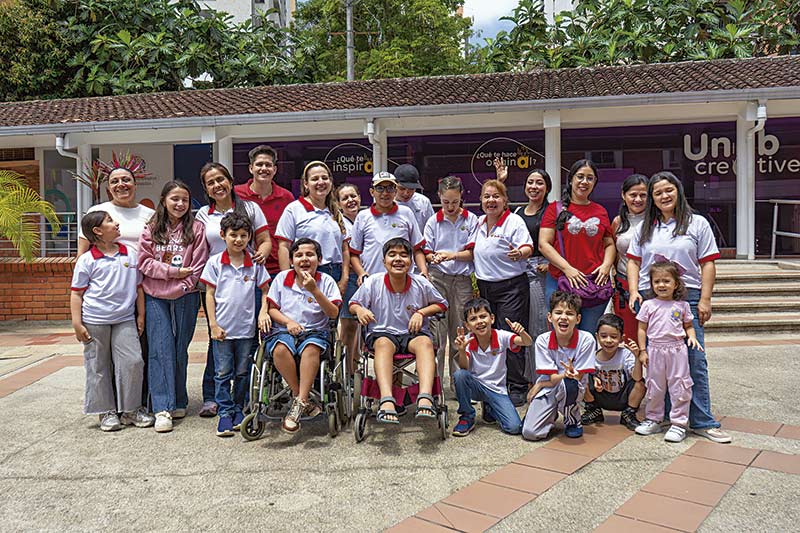
La Mantita Gris began supporting children with autism, ADHD, Down syndrome, Duchenne muscular dystrophy, and other conditions in 2021. Photo: Alejandra Gualdrón Acevedo
Transforming Public Schools
Institución Educativa San Francisco de Asís is a public school that has served its community for more than 60 years. Located in Bucaramanga’s Santander neighborhood, it borders other low-income areas, including the 12 de Octubre settlement, where a fire destroyed more than 50 homes in December 2025.
Many children affected by that fire attend the school, and some will participate in the second 2026 cohort of Liderando y Transformando-Me. Every two weeks, UNAB volunteers visit fourth- and fifth-grade students to lead leadership workshops.
The program takes a holistic approach, emphasizing the development of soft skills focused on personal growth while encouraging students to build a stronger connection with their communities. As the culmination of their training, participants identify a challenge affecting their community and present a solution based on what they have learned.
“For a university specializing in higher education to create a program that provides complementary learning opportunities for schoolchildren is an extraordinary opportunity. Schools often lack the resources to bring in professionals from different fields. This partnership allows us to offer learning experiences that would otherwise not be possible because of financial and infrastructure constraints,” says Gerardo Andrés Barbosa Mendoza, the school’s principal.
 By Franz Dieter Hensel Riveros
 Por Erika Alcira González Pinto